
How to Fix Poor Yard Drainage in Markham: 9 Landscaping Solutions for Standing Water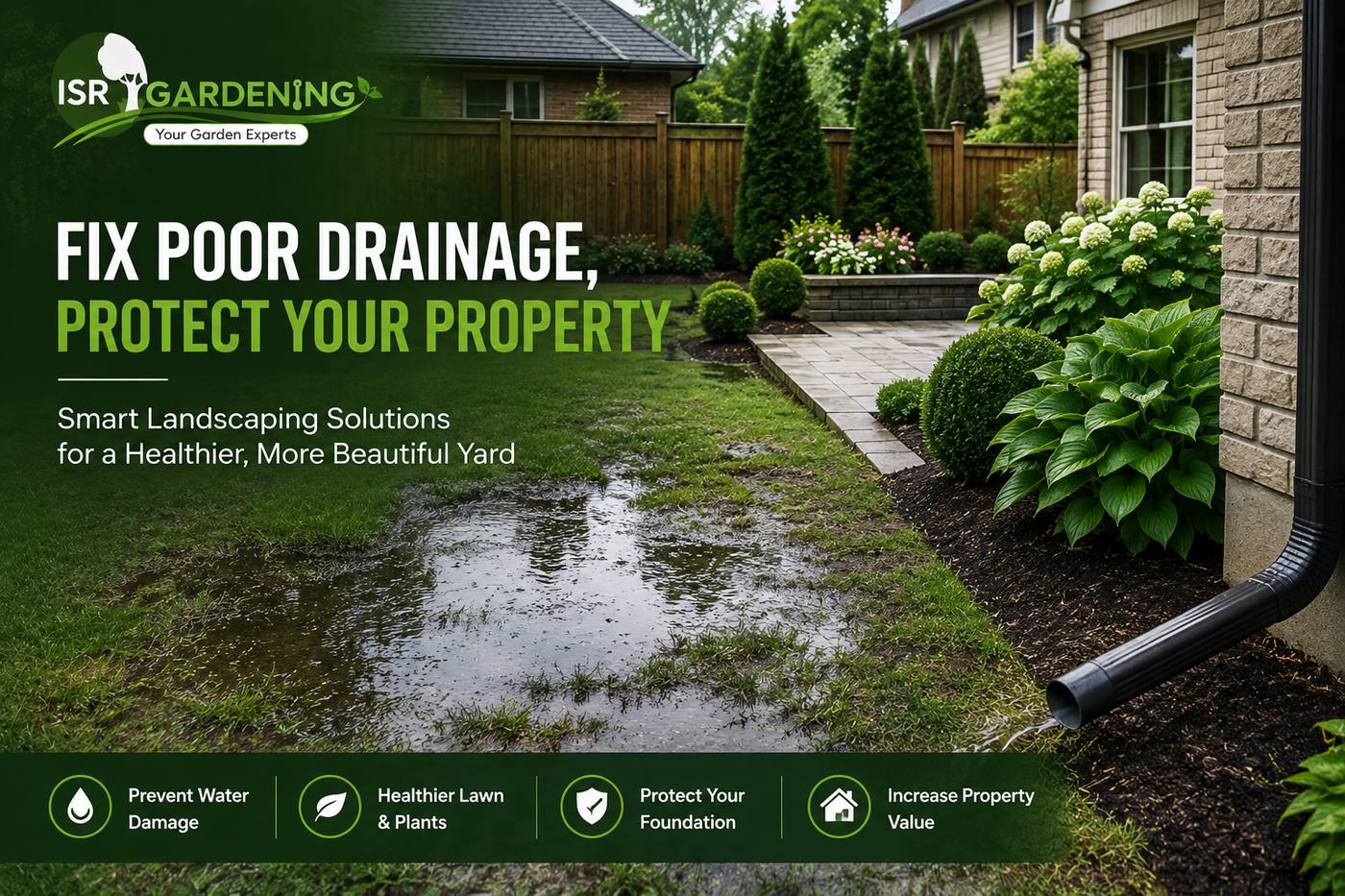
Have you noticed puddles that remain on your lawn long after it rains? Does water collect beside your patio, driveway, garden beds, or foundation?
Poor yard drainage is more than an inconvenience. Over time, excess water can damage your lawn, weaken plants, create muddy areas, contribute to erosion, and make parts of your property difficult to use.
For homeowners in Markham and the Greater Toronto Area, drainage should be considered before installing new sod, gardens, interlocking, or other major landscaping features.
At ISR Gardening, we believe a beautiful landscape needs a strong foundation. Here’s what homeowners should know about identifying and improving common yard drainage problems.
What Causes Poor Yard Drainage?
There isn’t one single cause of standing water.
Several conditions can contribute to drainage problems, including:
- Incorrect grading
- Low areas in the lawn
- Compacted soil
- Heavy soil
- Downspouts releasing water in unsuitable locations
- Poorly designed garden beds
- Improperly constructed hardscaping
- Landscape changes that alter water movement
Sometimes several of these issues occur on the same property.
1. Correct the Grading of Your Yard
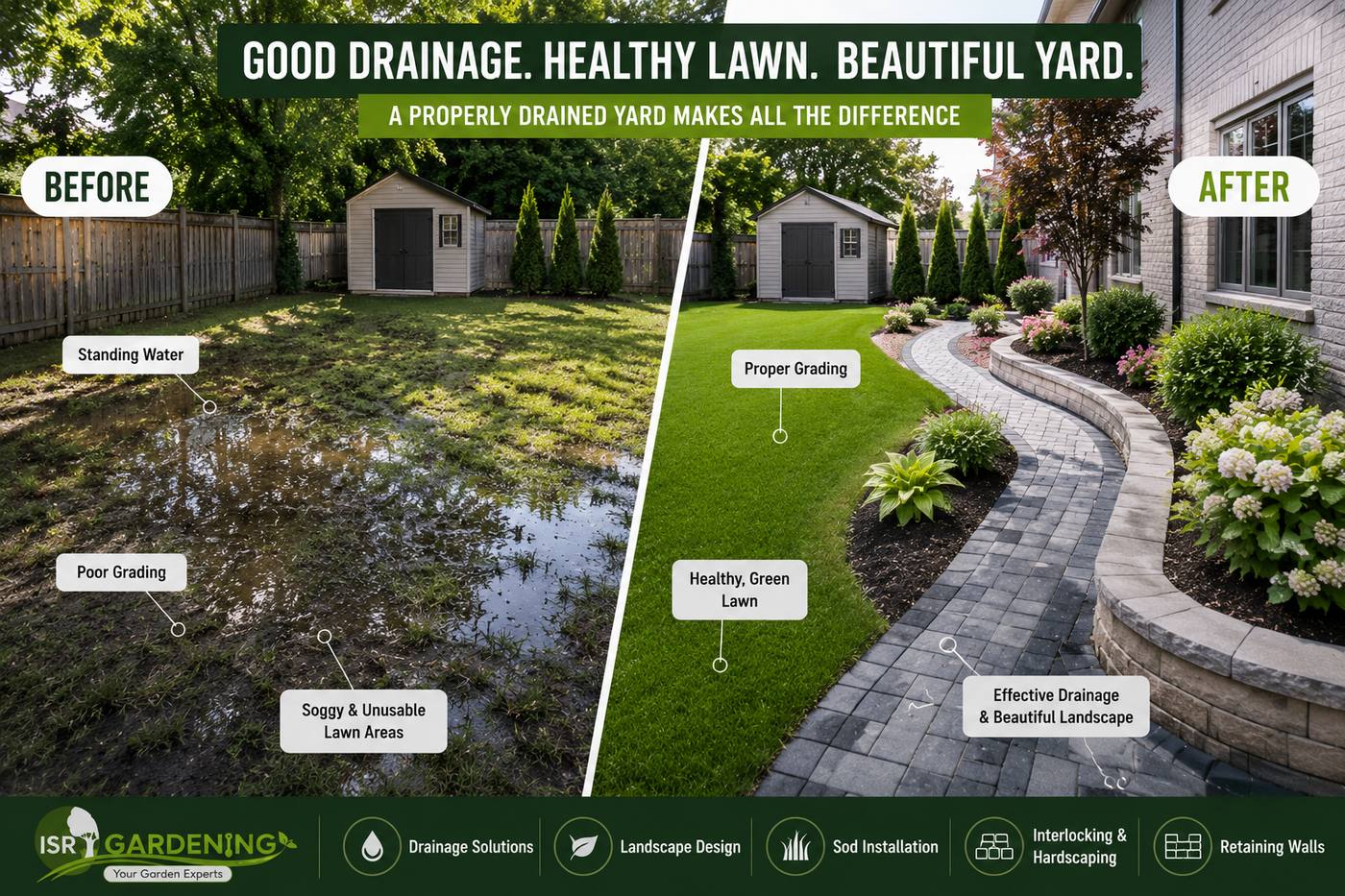
Grading describes the slope and elevation of the ground around your property.
Water naturally follows gravity, so the shape of the landscape determines where rainfall travels.
Low spots can collect water instead of allowing it to move away.
Depending on the property, landscape grading may involve reshaping certain areas and adding or removing soil to improve surface drainage.
Correct grading is especially important when you’re planning a new lawn or larger landscape renovation.
2. Fix Low Spots in the Lawn
Does the majority of your lawn drain properly except for one or two areas?
You may simply have low spots.
These depressions can develop from settlement, previous landscaping, heavy traffic, or improper preparation.
After rainfall, water collects in the depression and creates a puddle.
Depending on the severity of the problem, correcting the underlying grade before restoring the grass can provide a better long-term solution than repeatedly trying to repair damaged turf.
3. Improve Compacted Soil
Compacted soil can prevent water from penetrating the ground effectively.
Instead of being absorbed, rainfall can remain near the surface or move toward another low area.
Soil compaction commonly occurs in areas experiencing significant:
- Foot traffic
- Construction activity
- Equipment traffic
- Lawn use
For lawn areas, aeration may help improve the movement of air and water into the soil.
More significant landscaping projects may require additional soil preparation.
4. Check Your Downspouts
Sometimes the lawn isn’t the real source of the problem.
Look at where your home’s downspouts discharge during rainfall.
If large amounts of roof water are being released directly into a problem area, that concentrated flow may overwhelm the surrounding landscape.
A properly planned landscape needs to account for water coming from the house as well as rain falling directly onto the yard.
Homeowners should ensure any drainage changes comply with applicable municipal requirements and don’t improperly direct water onto neighbouring properties.
5. Consider Drainage Before Installing New Sod
This is particularly important.
If your existing lawn has standing-water problems, simply covering it with beautiful new sod doesn’t necessarily solve the underlying issue.
The lawn may look fantastic immediately after installation, but unresolved drainage problems can continue affecting the area.
Before installing sod, evaluate:
- Existing grade
- Low areas
- Soil condition
- Water movement
- Surface preparation
Good preparation helps create better conditions for the new lawn to establish.
ISR Gardening already provides professional sod installation as part of its lawn-care services.
6. Design Garden Beds With Drainage in Mind
Garden beds can make a property considerably more attractive, but they also influence how water moves through the landscape.
Soil elevation, borders, plants, mulch, and surrounding hardscape should all be considered.
Plants also have different moisture requirements.
A location that’s perfect for one species may be unsuitable for another.
Thoughtful garden design considers both appearance and the actual growing conditions on the property.
7. Use Hardscaping Strategically
Interlocking patios and walkways are excellent additions to a landscape when they’re properly planned and constructed.
However, hard surfaces influence where rainwater travels.
The base preparation, elevation, slope, surrounding landscape, and drainage strategy all need to work together.
This is one reason professional installation matters.
You don’t want to solve one landscape problem while unintentionally creating another.
ISR Gardening provides interlocking installation, driveway and walkway interlocking, backyard/patio interlocking, and retaining-wall services, making drainage-related content particularly relevant to the services already presented on your website.
8. Use Retaining Walls Where Appropriate
Properties with elevation changes can require more sophisticated landscape planning.
Retaining walls can help manage grade transitions, create usable landscape areas, and provide structure to sloped properties.
But a retaining wall isn’t simply a decorative wall.
Water pressure and drainage behind and around retaining structures need to be considered during proper design and construction.
For significant drainage or structural issues, homeowners may need an appropriately qualified drainage, engineering, or construction professional depending on the scope of the project.
9. Build the Landscape Around the Property
The best drainage solution isn’t necessarily the same for every home.
One property may need relatively simple grading corrections.
Another might require a combination of:
grading + soil preparation + hardscape planning + garden design + lawn restoration.
That’s why drainage should be considered as part of the entire landscape rather than treating every puddle independently.
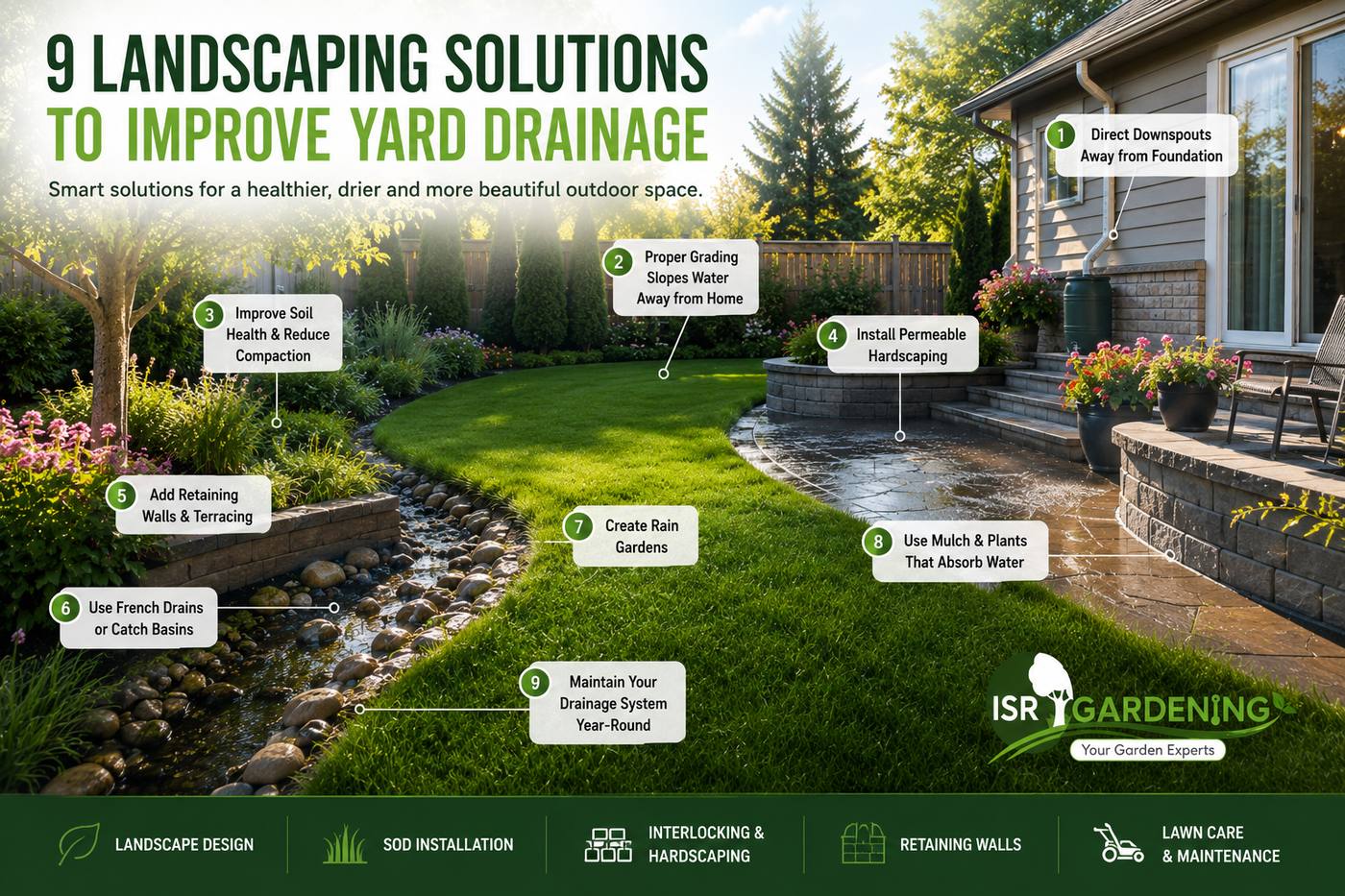
Signs Your Yard May Have a Drainage Problem
Watch for:
Water Remaining After Rain
Some temporary surface water during heavy rainfall can occur, but areas that repeatedly remain saturated deserve attention.
Constantly Muddy Grass
If one section of the lawn stays muddy while surrounding areas dry normally, investigate what’s causing it.
Thin or Damaged Grass
Persistent moisture and poor soil conditions can contribute to unhealthy lawn areas.
Soil Erosion
Moving water can gradually carry soil away from garden beds, slopes, or other parts of the property.
Water Collecting Around Hardscaping
Recurring pooling around patios and walkways may indicate that elevations or surrounding drainage need attention.
Uneven Lawn Areas
Dips and depressions often become collection points for rainfall.
Can Landscaping Improve Yard Drainage?
In many situations, yes.
Professional landscaping isn’t only about making a property attractive.
Good landscape planning considers how the entire property functions.
That includes:
water movement, grading, soil, plants, lawn areas, hardscaping and how homeowners use the property.
Correcting these underlying issues can make it easier to maintain a healthy lawn and attractive gardens while creating outdoor areas that are more enjoyable to use.
Planning a Landscape Renovation? Address Drainage First
If you’re considering a major backyard transformation, new sod, garden beds, retaining walls, or interlocking, drainage should be evaluated during the planning stage.
It’s much easier to address underlying landscape conditions before installing the finished features.
Think of drainage as the foundation of your outdoor project.
You may not notice it when everything works properly—but you’ll certainly notice when it doesn’t.
Professional Landscaping in Markham
ISR Gardening provides professional landscaping and lawn-care services for homeowners throughout Markham, Richmond Hill, Vaughan, Toronto and surrounding GTA communities. Your website currently lists services ranging from landscape design and interlocking to retaining walls, sod installation, lawn care and gardening.
Whether you’re dealing with an unhealthy lawn, planning a new landscape, or looking to completely transform your outdoor space, proper preparation can make a significant difference in the finished result.
Ready to Improve Your Outdoor Space?
Don’t keep repairing the same muddy or damaged areas without investigating what may be causing the problem.
A thoughtfully planned landscape can improve both the appearance and functionality of your property.
🌿 ISR Gardening — Your Garden Experts
📞 Call (416) 831-7076 to request a free landscaping estimate.
📍 Serving Markham, Richmond Hill, Vaughan, Toronto & surrounding areas.